
No-cost & low-cost EMI available on transactions (Bill / Order Value) above ₹3,000. Applicable on most credit cards. Enquire at reception or contact us via call, email, WhatsApp, or website.
Trust badges

NABH & NABL Accredited

Cardiologist-Reviewed Reports

Home Service Available

What Is A Holter Test?
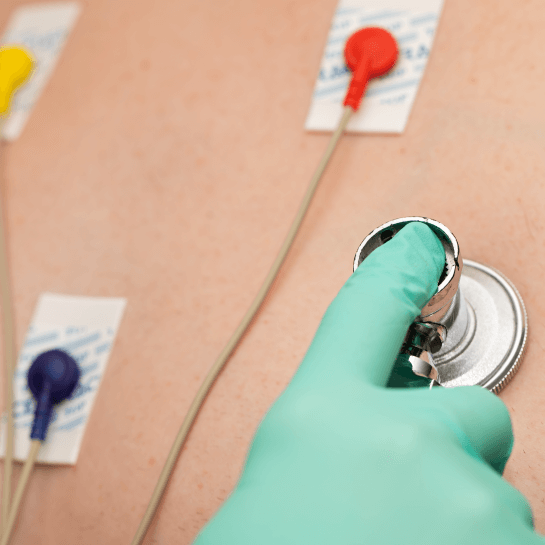
A Holter test is a portable, continuous ECG (electrocardiogram) recording that captures your heart’s electrical activity over an extended period — from 24 hours up to 7 days, depending on what your doctor recommends. You wear a compact, battery-operated device attached to a few small electrodes on your chest and simply go about your normal day.
Unlike a standard ECG, which lasts only a few minutes at the clinic, a Holter monitor records every heartbeat continuously over days. This makes it possible to capture irregular rhythms that only occur occasionally — during exercise, stress, sleep, or at unpredictable moments a short in-clinic test would miss.
Key facts at a glance



Starting from ₹2,500 (price based on duration)


Prescription Required (doctor’s referral)
Diagnostic disclaimer: This test is a diagnostic aid. Results are reviewed and interpreted by a qualified RxDx cardiologist. A Holter recording does not constitute a standalone diagnosis. Your doctor will discuss findings and recommend next steps.
Why Would a Doctor Refer You for a Holter Test?
A Holter test is recommended when you have symptoms that come and go — and a standard ECG hasn’t captured them. The duration of monitoring is decided by your doctor based on how frequently your symptoms occur and what needs to be investigated.
| Your symptom or concern | What the Holter test looks for |
|---|---|
| Heart palpitations, fluttering, or skipped beats | Ectopic beats (PACs / PVCs), irregular rhythm patterns |
| Unexplained dizziness or lightheadedness | Arrhythmias causing momentary reduction in blood flow |
| Fainting spells (syncope) or near-blackouts | Bradycardia, pauses, or conduction blocks during the episode |
| Chest pain not captured on a standard ECG | Myocardial ischaemia — reduced blood flow to the heart muscle |
| Irregular heartbeat (known or suspected) | Atrial fibrillation, tachycardia, or bradycardia |
| Pacemaker check-up or medication review | Pacemaker function, response to heart rhythm medication |
Conditions a Holter test can help identify
- Atrial Fibrillation (AFib) — an irregular, chaotic heartbeat that increases stroke risk
- Tachycardia — episodes of abnormally fast heartbeat
- Bradycardia — unusually slow heart rate causing fatigue or fainting
- Premature beats (PACs / PVCs) — extra or skipped beats
- Myocardial Ischaemia — reduced blood flow to the heart muscle
How The Holter Test Is Done
Step-by-Step: What to Expect
Step 1 — Preparing for the test
- Shower before your appointment — you will not be able to bathe while wearing the device
- Do not apply lotions, oils, or creams on your chest on the day of the test
- Wear a loose, comfortable two-piece outfit — a button-down shirt is ideal
- Men may need a small area of chest hair shaved for the electrodes to stay in place
- Bring your doctor’s prescription and any previous ECG or cardiac reports
Step 2 — Device fitting (at the clinic, or at your home for home service)
A trained RxDx cardiac technician will clean the electrode sites on your chest, attach small adhesive electrode patches, and connect them to a compact, battery-operated Holter recorder. The technician will check signal quality and give you a symptom diary to use during the recording period.
Step 3 — During the recording
What you can do:
- Go to work, take gentle walks, cook, watch TV, sleep normally
- Press the ‘Event’ button on the device when you feel a symptom — palpitation, dizziness, or chest discomfort
- Note the time and activity in your symptom diary — critical for accurate analysis
What to avoid:
- Getting the device or electrodes wet — no baths, showers, or swimming
- Heavy exercise or contact sports unless specifically instructed by your doctor
- Strong electrical or magnetic fields — MRI machines, metal detectors, electric blankets
- Electric razors or toothbrushes used close to the device
Step 4 — Returning the device
At the end of the recording period, return the device to the RxDx clinic where it was fitted — or, if you have the home service, an RxDx technician will visit your home to collect it. Electrodes are removed quickly and painlessly, and the full recording is downloaded for analysis.
Step 5 — Your report (ready in 3 working days)
Your recording goes through a five-stage review process:
- AI rhythm analysis — automated algorithms scan every recorded heartbeat and identify rhythm patterns across the full recording
- Cardiac technician review — a trained RxDx cardiac technician goes through the entire recording, validates the AI findings, and manually annotates any additional rhythms or events
- Combined analysis — the AI’s rhythm interpretation and the technician’s manually analysed data are compiled together into a complete picture of your heart’s activity during the recording period
- Cardiologist review — the combined analysis is reviewed by an experienced RxDx cardiologist, who interprets all findings in the context of your symptoms and medical history
- Report sign-off — the cardiologist signs off the final report, which is then prepared and sent to you
Your report is available as a soft copy sent to your registered email, as a hard copy collected at the clinic — or both. Most patients choose both.
Report disclaimer: Holter reports are prepared by NABH-accredited technicians and reviewed by experienced RxDx cardiologists. This report is a diagnostic aid — please consult your treating doctor for clinical advice.
What Does Your Holter Report Show?
A Complete Picture of Your Heart Over Time
Your RxDx Holter report is not just a number or a single result — it is a detailed, multi-page clinical document prepared by our cardiology team. Here is what each section of the report tells you and your doctor.
| Report Section | What it contains | What it means for you |
|---|---|---|
| Summary Findings | Total heartbeats recorded, ventricular ectopic count and percentage, supraventricular ectopic count, fusion beats, signal quality | Gives your doctor the overall scale of the recording and how much of the heart’s activity was abnormal versus normal |
| Heart Rate Summary | Minimum heart rate (with exact time it occurred), maximum heart rate, average heart rate over the full recording period | Reveals how high or low your heart rate went, and exactly when — for example, whether a fast rate happened during sleep, exertion, or at rest |
| Ventricular Events | Counts of bigeminy (every other beat is abnormal), trigeminy, IVR/AIVR (slow abnormal rhythms), and VT/Poly VT (fast dangerous rhythms) | Identifies whether extra beats from the lower chambers are occasional or forming repetitive patterns, and whether any episodes of fast ventricular rhythm occurred |
| Supraventricular Events | Atrial bigeminy, Atrial Fibrillation (AFib), Atrial Tachycardia (AT), pauses longer than 2 seconds | Detects rhythm disturbances originating in the upper chambers of the heart, including AFib episodes and significant pauses that may explain dizziness or fainting |
| QT Interval Measurements | Maximum QT interval, maximum corrected QTc interval, and the times at which these occurred | A prolonged QT interval can indicate risk of serious arrhythmia. This is particularly important for patients on certain medications or with a family history of sudden cardiac events |
| Tachycardia Burden | Total number of tachycardia episodes and the percentage of total recording time spent in tachycardia | Helps your doctor understand how much of your day your heart was beating abnormally fast, and whether this is improving or worsening compared to previous tests |
| Arrhythmia Trend Timeline | A visual timeline across the full recording period marking critical events, major events, minor events, patient-triggered alerts, and day/night periods | Shows your doctor at a glance when abnormal events clustered — whether they were daytime, nocturnal, or triggered by specific activities you noted in your diary |
| R-R Analysis | R-R interval histogram (distribution of gaps between heartbeats) and R-R variation chart (how much the gaps vary beat to beat) | Reveals the regularity of your heart rhythm. A very narrow, consistent distribution suggests a regular rhythm; a wide, scattered distribution points to variability or irregular beats |
| Heart Rate — Sleep vs Awake | Separate heart rate statistics (minimum, maximum, average) broken down for sleeping and waking hours, with exact time windows | Isolates nocturnal arrhythmias, sleep-related bradycardia, or rates that don’t drop adequately during sleep — all of which have distinct clinical implications |
| Periodic Count Analysis | Hour-by-hour breakdown of heart rate and event counts across the full recording — ventricular events, supraventricular events, and nodal events listed per time block | Allows correlation between your symptom diary entries and the exact time blocks where the most events occurred — making diagnosis far more precise |
| Selected ECG Snapshots | Actual ECG tracings selected from the recording at clinically significant moments — including the fastest heart rate, slowest heart rate, and flagged arrhythmia episodes | Gives your cardiologist the actual electrical evidence behind every finding — not just a count, but a real look at what the heart was doing at that moment |
| Cardiologist’s Conclusion | A plain-language clinical summary written by the RxDx cardiologist, interpreting all findings in the context of your symptoms and medical history | This is the section your treating doctor will act on. It summarises the rhythm, any abnormalities found, their significance, and any recommended next steps |
A note on reading your report
Your Holter report contains a large amount of technical data — hundreds of thousands of heartbeats analysed across multiple dimensions. It is prepared specifically for your treating cardiologist, who will interpret the findings in the context of your symptoms, history, and medication. The Conclusion section is the most directly relevant part for you as a patient. Please do not attempt to self-diagnose from the technical pages — always review the full report with your doctor.
Prefer to Stay Home? We Come to You.
The test price is the same whether you come to the clinic or opt for our home service — it is based on the duration of monitoring your doctor recommends. Home service simply means an RxDx technician visits your home for device fitting, collection at the end of your test, or both. A visit charge applies for each technician trip.

Clinic Setup
Visit the clinic for device fitting; return device after your test duration
Home visit service
RxDx technician visits your home — for fitting, collection, or both
Home visit options: Fix only — technician fits device at home; you return it to clinic. | Remove only — you visit clinic for fitting; technician collects from home. | Fix + Remove — technician handles both ends. Most patients choose this. Visit charge applies per trip.
To book home service or confirm coverage at your address, call 9014091111 or WhatsApp +91 9019961402.
Holter Test Cost In Bangalore
Pricing is based on the duration of monitoring your doctor recommends.
The test price is the same whether the device is fitted at the clinic or at your home.
| Duration | Booking | Whitefield, Kadugodi, Siddapura (Varthur), Budigere areas | Malleswaram area |
|---|---|---|---|
| 24 hours | Online / walk-in | ₹2,500 | ₹3,000 |
| 7 days | Online / call | ₹10,000 | ₹21,000 |
| Any other duration (25 hours to 27 days) based on doctor’s advice | Call to enquire | Priced by duration — call 9014091111 | Priced by duration — call 9014091111 |
Base charge
₹400 per
technician visit
₹25 per km
beyond 5 km from the clinic
Applies to
Each technician visit — fix and collect charged separately if booked individually
Pricing note: Test price is the same at clinic or at home — determined solely by duration. Home visit charges billed separately. All prices include the Holter Test report and technician service. GST as applicable. T&C apply. Doctor prescription required.
Easy EMI Available
Pay in easy, zero-cost instalments. RxDx offers flexible EMI options on bill value above ₹3,000 to make cardiac diagnostics accessible without financial stress.
Why Choose Rxdx Clinics?

NABH & NABL Accredited
Independent quality certification. Our labs meet national standards for diagnostic accuracy and safety — something you can verify publicly.
Cardiologist-Reviewed Reports
Every Holter recording is interpreted by an experienced RxDx Cardiologists— not just software output.
24 Hours to 27 Days
Holter monitoring is customisable to exactly what your doctor prescribes — from a single day to nearly a month of continuous recording.
Home Service Available
RxDx technicians visit your home for device fitting, collection, or both — at the same test price. A small visit charge applies per trip.
Zero-Cost EMI
Spread your payment in easy instalments at no extra cost.
Know More

Flexible Report Delivery
Receive your report by email, collect a hard copy at the clinic, or both. No need to visit the clinic just for your report if you prefer digital delivery.

Integrated Cardiac Care
ECG, TMT, Echocardiography, and specialist consultations all available at RxDx — your next step is always within reach.
Is a Holter Test Safe?
Yes. A Holter test is entirely non-invasive and painless. The device records electrical signals from your body — nothing is inserted, no radiation is involved, and there is no risk from the monitoring process itself.
- Some people experience mild skin irritation or itchiness around the electrode adhesive sites — this is temporary and resolves once the electrodes are removed
- If you have a known adhesive allergy, inform the technician before the test begins
- Gently press it back down, or reconnect the lead clip if it has come off
- If unsure, call the clinic rather than stopping the test: 9014091111
- Do not end the test on your own without medical guidance
Related Cardiac Diagnostic Services At RxDx
ECG (Electrocardiogram)
Ideal for: Chest pain, routine check-up
Echocardiography (Echo)
Ideal for: Murmurs, valve disease, heart failure
Stress Test (TMT)
Ideal for: Chest pain on exertion, CAD screening
ABPM (24-Hr BP Monitor)
Ideal for: High BP, medication review
Comprehensive Cardiac Health Check
Ideal for: Annual screening, family history of heart disease
Booking & Locations
- RxDx Clinics, Siddapura (CHANDY)
- RxDx SAMANVAY Clinics, Malleswaram
- RxDx Clinics, Whitefield
- RxDx Clinics, Kadugodi
- RxDx Clinics, Budigere Cross
- RxDx Clinics, Sarjapur Road (Dommasandra)
- RxDx Clinics @ NM Medical, Domlur
- RxDx Clinics, Jakkur (North Bengaluru)
- RxDx Clinics, RR Nagar
- RxDx Clinics, Electronic City
Frequently Asked Questions (FAQs)
What is a Holter monitor and why would I need one?
A Holter monitor is a portable ECG device that records every heartbeat continuously for a period determined by your doctor — from 24 hours up to 7 days. It helps detect arrhythmias that a short in-clinic ECG might miss. Doctors recommend it for palpitations, dizziness, fainting, chest pain not captured on a standard ECG, or to evaluate pacemaker function.
How long does the Holter test last?
How do I prepare for a Holter test?
What should I avoid while wearing a Holter monitor?
What should I do during the test?
Continue your normal daily routine. Keep a diary — log the time, activity, and any symptoms you notice. If you feel a palpitation, dizziness, or chest discomfort, press the Event button on the device and note it in your diary immediately. This helps your cardiologist match your symptoms to the exact point in the recording.